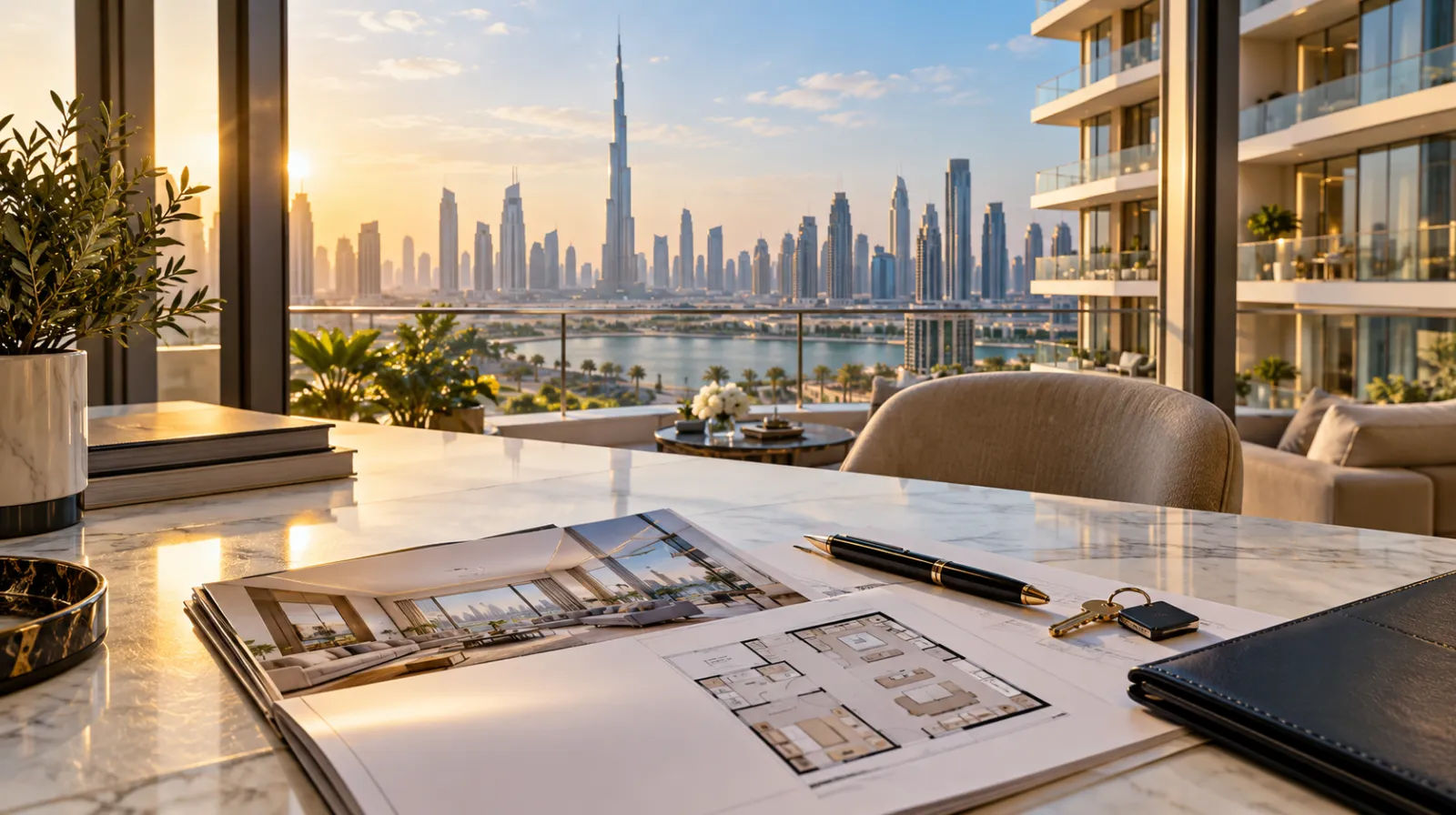
How to buy apartment in dubai starts with a simple process: set your goal and budget, confirm you can buy in the right area, arrange funds, verify the property, and complete registration safely. This guide is for investors, end-users, residents, and non-residents who want a practical view of the process, costs, requirements, and risk checks before they commit. So, what should you verify before you sign or transfer money?
Key Takeaways
- Foreigners can buy apartments in designated areas in Dubai, including through freehold, usufruct, or leasehold rights where applicable.
- A typical buying path is: define your goal, choose an eligible area, arrange cash or financing, shortlist units, sign the MoU, complete NOC and transfer steps, then receive the title deed and handover.
- Your total cost is not just the apartment price. Buyers should also budget for registration-related charges, agency costs, financing costs if needed, and ongoing ownership expenses.
- Property ownership may support residency options in some cases, but it is not automatic, and it is not citizenship.
- Rules, fees, lender criteria, and visa thresholds can change, so verify current details before committing. Educational content; verify current rules with official sources.
Quick Steps, Costs, and Requirements
If you want the short version, buying an apartment in Dubai usually means choosing your budget and purpose, confirming area eligibility, arranging cash or mortgage approval, checking the apartment and seller, signing the MoU, then completing registration and title transfer through the official process. Foreigners can buy in designated areas, while residency-related steps are separate from the purchase itself.
| Topic | Fast answer |
| Main buying steps | Budget and goal, area check, financing, shortlist, offer and MoU, NOC, transfer, registration, and handover |
| Upfront cost categories | Property price, registration-related charges, admin fees, agency fees, mortgage costs if used, and NOC if applicable |
| Key purchase documents | Usually passport/ID copies, signed transaction forms, seller and property documents, and lender documents if financed |
| Residents vs foreigners | Foreigners can buy in designated areas; financing and residency documentation can differ by buyer profile |
| Residency after purchase | Possible in some cases if conditions are met, but separate approval rules apply |
Freshness note: fees, mortgage rules, and visa thresholds may change, so verify current details with official channels and lenders before you proceed.
Explore More: Apartments for sale in Dubai
Why Buying an Apartment in Dubai Can Be a Good Option
Buying can make sense if the apartment matches your real goal, holding period, budget, and risk tolerance. For some buyers, the priority is personal use and long-term stability. For others, it is rental demand, resale flexibility, or access to residency-linked options. It is usually a stronger decision when you compare neighborhoods, costs, and exit options calmly rather than treating every listing as a good fit.
- For investors: the main question is whether the unit fits your strategy, expected hold period, and total cost base.
- For end-users: buying can make sense if you want more control over where you live and expect to stay long enough for the costs to be justified.
- For residency-minded buyers: ownership can support some residency routes if specific conditions are met, but ownership alone is not a guarantee.
- For lifestyle buyers: community access, commute, schools, building quality, and monthly ownership costs often matter as much as the purchase price.
- Is now a good time to buy? That depends more on your purpose, financing position, and how long you plan to hold than on any universal market timing claim.
How to Buy an Apartment in Dubai, Step by Step
The Dubai apartment buying process is easier to manage when you break it into clear stages. The exact sequence can vary slightly between ready and off-plan purchases, but the core decision path is similar: define what you need, verify what you can buy, line up your funds, review the property carefully, and complete the transfer through the official registration route.
Explore More: Buying Property in Dubai as a Foreigner
Define Your Budget and Goal
- Decide whether this purchase is mainly for investment, self-use, or residency support.
- Set a full budget that includes purchase costs and not only the apartment price.
- Decide early whether you are a cash buyer or plan to use a mortgage.
- Pick your target unit type: studio, one-bedroom, family apartment, or larger unit.
- Narrow your preferred community by commute, lifestyle, schools, building age, and tenant demand if investing.
- Set clear deal filters: maximum budget, minimum size, parking need, view preference, and acceptable building condition.
Buying in Freehold Areas
Foreigners can buy apartment units in designated areas in Dubai. The key ownership concepts are simple: freehold means ownership rights in the property, usufruct is a right to use and benefit from a property for a set period, and leasehold generally gives rights for a limited term rather than full ownership. The latest eligible areas should be verified before you commit.
| Area examples for market research only | Typical buyer profile | Budget positioning |
| Central established apartment districts | End-users and long-term investors | Mid to upper-mid |
| Marina or waterfront apartment districts | Lifestyle buyers and short-stay rental investors | Upper-mid to high |
| Newer master-planned communities | First-time buyers and value-focused investors | Entry to mid |
| Luxury branded or prime districts | Luxury buyers and prestige-focused investors | High to premium |
These are market-style examples, not an official list of freehold areas, so confirm current area eligibility before proceeding.
Cash or Mortgage
- Cash route: confirm where your funds will come from, what payment stages apply, and how quickly you can complete.
- Mortgage route: speak to lenders early and seek pre-approval before you negotiate seriously.
- Resident and non-resident bank criteria can differ.
- Financing should be arranged before negotiation, so you know your real budget and can avoid delays later.
- Budget for lender processing, valuation, and other finance-related costs where relevant.
- Freshness note: loan-to-value rules, down payment expectations, and bank criteria can change, so confirm current terms directly with lenders.
Explore More: UAE Mortgage Calculator
Working With a RERA-Licensed Agent
A licensed agent can reduce process risk by helping you filter listings, compare units, negotiate terms, and coordinate paperwork in the right order. A good agent should also help you spot weak listings, explain the transfer path, and keep the timeline realistic. Before working closely with any broker, ask them to show current licensing details and make sure they can explain the transaction steps clearly.
Viewing and Shortlisting
Use viewings to compare facts, not just finishes.
- Check the building lobby, elevators, parking, and shared areas.
- Ask about current service charges and what they cover.
- Review the apartment layout, natural light, storage, noise, and maintenance condition.
- Check whether the building feels owner-occupied, tenant-heavy, or holiday-let heavy.
- Ask about developer or building management reputation.
- For off-plan, look at delivery history and project clarity.
- For ready units, inspect air conditioning, bathrooms, kitchen, windows, and visible wear.
- Check community fit: access roads, retail, schools, beach, metro, or office corridors.
- If investing, ask whether the unit is easy to lease and easy to resell.
Making an Offer and Signing the MoU
Once you choose a unit, the next step is usually the offer and negotiation stage. If terms are agreed, the parties move to the Memorandum of Understanding, often called Form F in the secondary market. Before signing, slow down and check that the names, property details, price, payment stages, timelines, included items, and default terms match what was agreed.
- Confirm the exact purchase price and what is included.
- Review the deposit requirement carefully; the amount can vary by transaction.
- Check whether the seller has any finance on the property or conditions to clear before transfer.
- Make sure dates for NOC, transfer, and final payment are written clearly.
- If buying with a mortgage, confirm lender conditions before you sign.
- If anything is unclear, ask for clarification before funds move.
NOC, Transfer, and Registration
For a typical secondary-market purchase, the completion stage usually follows a set sequence tied to official registration and title issuance. Land title registration is handled through the official system, and the title deed is the formal proof of ownership.
- Apply for the NOC, or No Objection Certificate, if the transaction requires it.
- Confirm that seller obligations, outstanding dues, and supporting documents are in order.
- Schedule the transfer through the official transfer channel or trustee route used for registration.
- Complete final payment in the agreed format.
- Finalize registration so the ownership transfer is recorded officially.
- Receive the title deed as the official record of ownership.
Completing the Handover
After transfer, focus on the practical finish line: getting the keys, confirming the apartment’s condition, and checking what costs or building requirements start immediately. For ready units, make sure utilities, access cards, parking, and any pending maintenance points are clear before you consider the transaction fully complete. Move-in utility steps are handled separately after the relevant occupancy documentation is in place.
Explore More: Off Plan Apartments for Sale in Dubai
Off-Plan vs Ready Apartment: Which Option Is Better?
The right choice depends on what matters more to you: payment flexibility and future delivery, or immediate inspection and ownership transfer. Off-plan means buying before completion from a developer. Ready means buying a completed unit, often on the secondary market, where you can inspect the actual apartment before you close.
| Factor | Off-plan apartment | Ready apartment |
| Upfront cost structure | Often staged over time | More immediate at the purchase stage |
| Payment plan | Usually linked to a developer schedule | Usually linked to transfer timing and financing |
| Move-in timeline | Delayed until completion | Immediate or near-immediate after transfer |
| Inspection ability | You review plans, specifications, and sample materials | You can inspect the actual unit and building |
| Risk profile | Higher delivery and execution risk | Greater visibility into current condition and title status |
| Investor suitability | May suit buyers comfortable with future delivery and project risk | May suit buyers seeking current income potential or faster control |
| End-user suitability | May suit buyers planning ahead | May suit buyers who want to move in sooner |
Off-plan is better for buyers who want staged payments, can wait for delivery, and are comfortable with developer and project risk. Ready is better for buyers who want clearer inspection, faster use, and a more visible transfer path.
Explore More: Ready Apartments for Sale in Dubai
Buying an Apartment Safely: Risks and Due Diligence Checklist
A safe purchase is usually not about finding a perfect deal. It is about verifying ownership, documents, liabilities, building quality, and payment terms before money moves. The more clearly you understand the property and the process, the easier it is to avoid preventable mistakes.
Checking Legal Status
Use this as a pre-payment checklist.
- Confirm the seller has the right to sell the unit.
- Verify title status and ownership records through the official registration path.
- Check whether any mortgage, charge, or liability needs to be cleared before transfer.
- Confirm the apartment details match the official records.
- For off-plan, verify that project approvals and sales documents are in place.
- Make sure the transfer route and required documents are clear before you release funds.
Reviewing Developer and Building Quality
- Check the developer’s delivery track record for off-plan purchases.
- Ask whether earlier projects were handed over in line with what was promised.
- For ready apartments, assess maintenance quality in shared areas, not just inside the unit.
- Look for signs of weak upkeep: stained corridors, broken fixtures, poor parking management, or constant temporary repairs.
- Read building rules carefully if your use case depends on leasing flexibility.
- Compare at least a few buildings in the same area so you can spot quality differences.
Reviewing the Contract and Fees
- Review the payment schedule and trigger dates.
- Check what happens if either side delays or fails to complete.
- For off-plan, understand refund terms, delay clauses, and handover conditions.
- For ready property, check how final payment and transfer are linked.
- Clarify what fixtures, furniture, parking, or storage are included.
- Ask for a full list of fees before you commit.
- Confirm whether there are admin charges, NOC costs, financing costs, or building-related balances still outstanding.
Understanding the Real Costs
Many first-time buyers underestimate the gap between the list price and the real all-in cost. The safest approach is to treat every fee line as indicative until you confirm it for your exact transaction, especially if financing, a trustee transfer, or an NOC is involved.
Full Upfront Costs
| Cost category | What it usually covers | Practical note |
| Purchase price | The apartment value agreed with the seller or developer | Your starting cost, not your total cost |
| DLD-related charges | Registration and ownership-recording costs | Confirm the current amount before transfer |
| Registration or admin fees | Trustee, administrative, or related processing charges | Can vary by transaction path |
| Agency commission | Broker fee if an agent is involved | Confirm in writing before signing |
| Mortgage-related costs | Bank processing, valuation, and related lender charges | Applies only if the purchase is financed |
| NOC fee | Certificate required in some resale transfers | Check who is responsible for paying it in your transaction |
Figures are indicative and must be updated before the transaction.
Ongoing Apartment Costs
After purchase, budget for service charges, utilities, routine maintenance, and insurance where relevant. If you are buying for investment, also leave room for vacancy periods, reletting costs, and eventual resale expenses. These ongoing costs can materially affect whether a unit still makes sense after the initial purchase.
Buying an Apartment in Dubai as a Foreigner
Yes, buying an apartment in Dubai as a foreigner is possible in designated areas, and that is one of the most important starting points for non-resident buyers. The main differences usually relate to where you can buy, how you fund the purchase, and what documents or lender checks may apply.
- Foreigners can buy in designated areas.
- Ownership structures may include freehold, usufruct, or leasehold rights, depending on the property.
- Residents and non-residents may face different lender requirements if they want a mortgage.
- Usually required documents include identification, transaction forms, and property-related paperwork.
- If you plan to finance, bank limits and approval standards for non-residents vary, so check directly with lenders before making offers.
Buying an Apartment and Qualifying for a Visa
Buying property can support residency options in some cases, but it should be treated as a separate approval process rather than an automatic result of ownership. Residency is not citizenship, and both eligibility rules and document requirements should be checked carefully before you buy for that purpose.
A property owner may be granted a residence permit without a sponsor if the stated conditions are met, including document and property requirements. The property-owner route requires a fully constructed, fully owned, habitable property, along with supporting documents such as a property ownership certificate, passport copy, photo, and income or bank documents.
For Golden Residency through property investment, the total property value must be at least AED 2,000,000, with ownership registered in the investor’s name. Financed property may qualify if the loan is from an approved local bank, and qualifying off-plan units may also count if bought from an approved local real estate company authorized by the competent local authority.
Best Areas to Buy an Apartment in Dubai, by Budget and Goal
There is no single best area for every buyer. The better question is which area best matches your budget, whether you want rental demand or self-use, and how much building or execution risk you are willing to take. The examples below are practical market categories for research, not guarantees or an official ranking.
| Area example | Buyer type | Budget level | Main advantage |
| Dubai Marina | Rental-focused or lifestyle investor | Upper-mid to high | Strong lifestyle appeal and broad tenant demand |
| Jumeirah Village Circle | Value-focused investor or first-time buyer | Entry to mid | Wider price accessibility and large apartment supply |
| Downtown Dubai | End-user or prestige buyer | High to premium | Central location and established profile |
| Business Bay | Investor or city-based end-user | Mid to high | Mixed-use location and broad resale audience |
| Dubai Hills Estate | Family end-user | Mid to high | Master-planned environment and lifestyle focus |
| Palm Jumeirah | Luxury buyer | Premium | High-end waterfront positioning |
Before choosing an area, compare building quality, exit flexibility, monthly costs, and how the apartment fits your actual use case.
Explore More: Highest ROI Areas in Dubai
Final Checklist Before You Transfer Money
Before funds move, slow the process down and make sure the apartment still works on paper as well as it did during the viewing. A clear final check can prevent rushed decisions at the most expensive stage of the transaction.
- Confirm your full budget, including all fees and immediate setup costs.
- Verify the property, seller identity, and ownership status.
- Review the contract terms, payment milestones, and default language.
- Confirm your financing is ready if you are not buying in cash.
- Make sure the transfer path, required documents, and timing are understood by all parties.
- Check who is paying each fee and whether any balance remains on the unit.
- Do not transfer money until the documentation route is clear.
Frequently Asked Questions
Can foreigners buy an apartment in Dubai?
Yes. Foreigners can buy in designated areas in Dubai, and the recognized ownership structures can include freehold, usufruct, or leasehold rights depending on the property.
How to buy an apartment in Dubai as a non-resident?
A non-resident usually follows the same core route as any buyer: choose an eligible area, arrange funds or discuss financing early, verify the property, sign the MoU, then complete transfer and registration. Financing rules can differ by lender, so confirm them before you negotiate.
How much money do you need to buy an apartment in Dubai?
You need the apartment price plus transaction costs and a reserve for ongoing ownership costs. The exact total depends on the property, whether you use a mortgage, and what fees apply to your transaction path.
What are the fees to buy an apartment in Dubai?
Typical fee categories include registration-related charges, admin fees, agency fees, mortgage-related costs if financed, and an NOC fee if the transaction requires one. Check the current amounts before you commit.
Is it safe to buy an apartment in Dubai?
It can be safer when you verify ownership, title status, liabilities, and contract terms carefully, and when the transfer is completed through the official registration route.
How to buy an apartment in Dubai with a mortgage?
Start by speaking with lenders early, seek pre-approval if possible, budget for finance-related costs, and only then negotiate seriously. That helps you know your real price range and avoid delays later.
Is buying an off-plan apartment in Dubai better than buying ready?
It depends on your goal. Off-plan may suit buyers who want staged payments and can wait for completion. Ready may suit buyers who want immediate inspection, a clearer current condition, and faster use.
What documents do you need to buy an apartment in Dubai?
Usually, buyers need identification documents and transaction paperwork. If you later apply under a property-owner residency route, the listed documents include a property ownership certificate, passport copy, photo, and income or bank documents.
Do you get residency if you buy an apartment in Dubai?
Not automatically. Property ownership may support residency options if the stated conditions are met, but approval is separate from the purchase and does not mean citizenship.